17 Low-Growing Perennials That Are Perfect to Grow Around Your Garden Border
By
Published on 04/12/25
:max_bytes(150000):strip_icc():format(webp)/GettyImages-1161212749-57df65a201584329ae8f4d87bb3ce8a6.jpg)
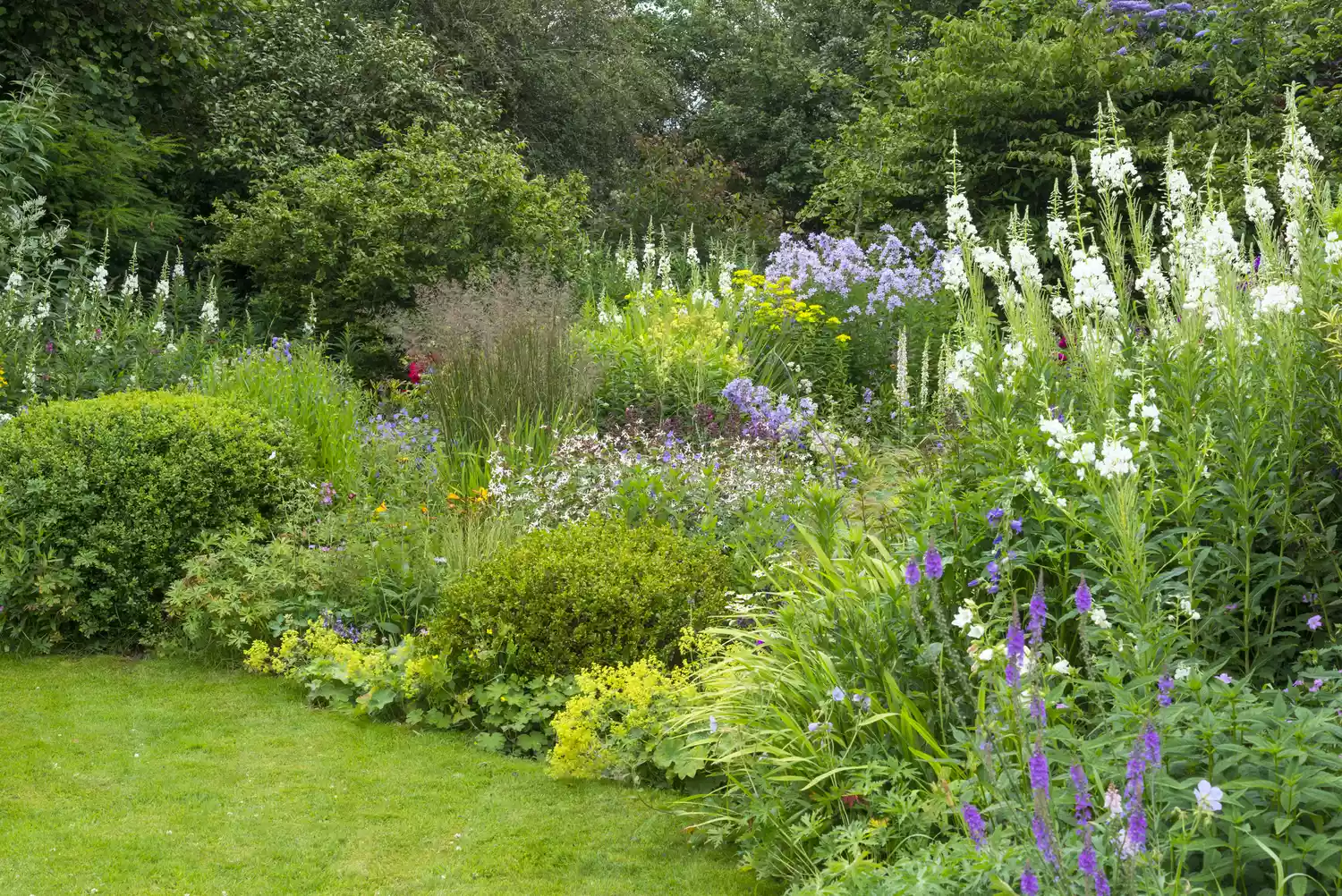
Gardeners often spend a lot of time deciding where to plant perennials, considering things like color, shape, and texture. Knowing the mature height of your perennials is key to choosing the best location, and many perennials have a wide range of sizes.
Miniature or dwarf cultivars of hostas and irises, or low-growing, creeping forms of plants like sedum and phlox, are perfect for the edges of flower beds. There are also plants with tall yet delicate flower stems (like coral bells) that work well in the front and don’t obscure the plants behind them. Below, we share the best low-growing perennials to elevate your garden border.
Want more gardening tips? Sign up for our free gardening newsletter for our best-growing tips, troubleshooting hacks, and more!
- 01of 17Woodland Phlox
:max_bytes(150000):strip_icc():format(webp)/ScreenShot2025-04-01at6.00.04PM-b33c701ebae843748ddfc1bc370a9836.png) Peg Aloi / The SpruceThis low-growing, shade-loving phlox blooms for weeks in spring. The flowers range from white to pale violet blue to lavender. Woodland phlox (Phlox divaricata) increases each year, and divides easily.
Peg Aloi / The SpruceThis low-growing, shade-loving phlox blooms for weeks in spring. The flowers range from white to pale violet blue to lavender. Woodland phlox (Phlox divaricata) increases each year, and divides easily.
- USDA Growing Zones: 4 to 7
- Mature Size: 10-12 in. tall, 18-inch spread
- Sun Exposure: Part shade to part sun
- Soil: Rich, well-draining
- 02of 17Cranesbill Geraniums
:max_bytes(150000):strip_icc():format(webp)/GettyImages-1845063574-b0af50a3c586488dbe54f11966b5294a.jpg) Alex Manders / Getty ImagesPerennial geraniums come in two forms: one that spreads via rhizomes and has short stems, and one that grows in clumps with long tendril stems. Both have sprightly flowers in a wide range of pinks, purples, and blues.
Alex Manders / Getty ImagesPerennial geraniums come in two forms: one that spreads via rhizomes and has short stems, and one that grows in clumps with long tendril stems. Both have sprightly flowers in a wide range of pinks, purples, and blues.
- USDA Growing Zones: 3 to 9 (may vary depending on cultivar)
- Mature Size: 9-18 in. tall, 1-3 feet wide
- Sun Exposure: Full to part sun
- Soil: Slightly acidic, moist, well-draining
- 03of 17Creeping Sedum
:max_bytes(150000):strip_icc():format(webp)/GettyImages-697067314-be1a57a952af4923a172852c3f93c22f.jpg) speakingtomato / Getty ImagesCreeping sedums are reliable, easy-care succulent ground covers. There’s a wide range of both flower and foliage colors. They’re perfect for edging the front of a sunny flower bed.
speakingtomato / Getty ImagesCreeping sedums are reliable, easy-care succulent ground covers. There’s a wide range of both flower and foliage colors. They’re perfect for edging the front of a sunny flower bed.
- USDA Growing Zones: 4 to 9
- Mature Size: 3-6 in. tall, 1-2 ft. wide
- Sun Exposure: Full to part sun
- Soil: Average to sandy, tolerates poor soil
- 04of 17Coral Bells
:max_bytes(150000):strip_icc():format(webp)/ScreenShot2025-04-01at5.30.51PM-0540012a91054637807120ad56f98a0f.png) Peg Aloi / The SpruceCoral bells (Heuchera) are named for the tiny pink flowers that grow on slender stems above the leafy clumps. Newer hybrids have foliage in many vivid colors, and they lend wonderful texture to the front of the border.
Peg Aloi / The SpruceCoral bells (Heuchera) are named for the tiny pink flowers that grow on slender stems above the leafy clumps. Newer hybrids have foliage in many vivid colors, and they lend wonderful texture to the front of the border.- USDA Growing Zones: 4a to 9a
- Mature Size: 8–18 in. tall, 12–24 in. wide
- Sun Exposure: Full to partial sun
- Soil: Acidic, neutral, moist and well-drained
- 05of 17Leadwort
:max_bytes(150000):strip_icc():format(webp)/GettyImages-1341492971-44c055caad6c45aaa3ebd6b21f7144d9.jpg) Nahhan / Getty ImagesLeadwort (Ceratostigma plumbaginoides) is a late summer bloomer with bright blue flowers. Also called hardy plumbago (sometimes confused with annual Plumbago auriculata), this plant wakes up somewhat slowly in spring.
Nahhan / Getty ImagesLeadwort (Ceratostigma plumbaginoides) is a late summer bloomer with bright blue flowers. Also called hardy plumbago (sometimes confused with annual Plumbago auriculata), this plant wakes up somewhat slowly in spring.
- USDA Growing Zones: 4 to 8
- Mature Size: 8-12 in. tall, 10-14 in. wide
- Sun Exposure: Partial to full sun
- Soil: Loamy, well-draining
- 06of 17Epimedium
:max_bytes(150000):strip_icc():format(webp)/GettyImages-950845408-077a65c1eac74a8c8e8d91ee3307f5c5.jpg) skymoon13 / Getty ImagesAlso known as barrenwort or fairy wings, epimedium is a spring-blooming ground cover with shapely leaves and delicate flowers in a range of colors. The roots form thick mats that usually need to be cut to divide them.
skymoon13 / Getty ImagesAlso known as barrenwort or fairy wings, epimedium is a spring-blooming ground cover with shapely leaves and delicate flowers in a range of colors. The roots form thick mats that usually need to be cut to divide them.
- USDA Growing Zones: 4 to 8
- Mature Size: 8-12 in. tall, 12-36 in. wide
- Sun Exposure: Full shade to part sun
- Soil: Tolerant of dry soils
- 07of 17Dwarf Hostas
:max_bytes(150000):strip_icc():format(webp)/GettyImages-1275470474-8e5d7beea4ce4207858ab5964f2fe924.jpg) Olga Seifutdinova / Getty ImagesFor your shady flower bed, dwarf hostas are a good choice for lush foliage in a wide range of colors and textures. Try ‘Pandora’s Box’ (variegated), ‘Blue Mouse Ears’ (steel blue), or ‘Sun Mouse’ (chartreuse green).
Olga Seifutdinova / Getty ImagesFor your shady flower bed, dwarf hostas are a good choice for lush foliage in a wide range of colors and textures. Try ‘Pandora’s Box’ (variegated), ‘Blue Mouse Ears’ (steel blue), or ‘Sun Mouse’ (chartreuse green).
- USDA Growing Zones: 4 to 7
- Mature Size: 6-12 in. tall, 10-18 in. wide
- Sun Exposure: Partial sun to full shade
- Soil: Average, clay, loam
- 08of 17Creeping Phlox
:max_bytes(150000):strip_icc():format(webp)/GettyImages-1317828819-2ff4bfa47ac74b66889a93118e44b172.jpg) Vladimir Lis / Getty ImagesCreeping phlox (Phlox sublata), has threadlike leaves and masses of flowers in shades of pink, purple, and white. They work well in rock gardens, edging paths, or spilling over sloped areas. Deadhead spent flowers to encourage reblooming.
Vladimir Lis / Getty ImagesCreeping phlox (Phlox sublata), has threadlike leaves and masses of flowers in shades of pink, purple, and white. They work well in rock gardens, edging paths, or spilling over sloped areas. Deadhead spent flowers to encourage reblooming.- USDA Growing Zones: 5 to 9
- Mature Size: 6-9 in. tall, 9-18 in. wide
- Sun Exposure: Full, partial
- Soil: Average, tolerates poor soils
- 09of 17Threadleaf Coreopsis
:max_bytes(150000):strip_icc():format(webp)/GettyImages-483989594-fca4fa18fdf5441dbcd705d94f2837b0.jpg) ZoomTravels / Getty ImagesCoreopsis is a sun-loving perennial with delicate daisy-like flowers. Many cultivars are compact like ‘Moonbeam,’ ‘Red Elf,’ ‘Jethro Tull,’ and ‘Darling Clementine’ (all between 8-15 in. tall). Deadhead to encourage fresh blooms.
ZoomTravels / Getty ImagesCoreopsis is a sun-loving perennial with delicate daisy-like flowers. Many cultivars are compact like ‘Moonbeam,’ ‘Red Elf,’ ‘Jethro Tull,’ and ‘Darling Clementine’ (all between 8-15 in. tall). Deadhead to encourage fresh blooms.
- USDA Growing Zones: 2 to 11
- Mature Size: 15-18 in. tall, 18-20 in. wide
- Sun Exposure: Full sun
- Soil: Average, well-draining
- 10of 17Bellflower
:max_bytes(150000):strip_icc():format(webp)/GettyImages-1977355240-6a0983586a9a4ccfa7a2144d45f22dd7.jpg) Charmian Perkins / Getty ImagesBellflower (Campanula) comes in various forms, from creeping to upright, withflowers that look like bells. Serbian bellflower ‘Blue Waterfall’ (Campanula poscharskyana) and Dalmatian bellflower (Campanula portenschlagiana) are shorter plants that spread gently and bloom for weeks.
Charmian Perkins / Getty ImagesBellflower (Campanula) comes in various forms, from creeping to upright, withflowers that look like bells. Serbian bellflower ‘Blue Waterfall’ (Campanula poscharskyana) and Dalmatian bellflower (Campanula portenschlagiana) are shorter plants that spread gently and bloom for weeks.
- USDA Growing Zones: 4 to 8
- Mature Size: 6 to 12 in. tall, 18-24 in. wide
- Sun Exposure: Part shade, part sun
- Soil: Average. Clay, sandy
- 11of 17Lady’s Mantle
:max_bytes(150000):strip_icc():format(webp)/GettyImages-2158625901-6d5599ab75544d4fba3b7e7987ec88aa.jpg) Andrew Linscott / Getty ImagesThis clumping shade perennial has rounded, scalloped leaves that glisten after rainfall. The dainty chartreuse flowers add subtle color to the late spring garden.
Andrew Linscott / Getty ImagesThis clumping shade perennial has rounded, scalloped leaves that glisten after rainfall. The dainty chartreuse flowers add subtle color to the late spring garden.
- USDA Growing Zones: 3 to 8
- Mature Size: 12–24 in. tall and wide
- Sun Exposure: Full, partial
- Soil: Neutral, acidic, loamy
- 12of 17Woods Blue Aster
:max_bytes(150000):strip_icc():format(webp)/GettyImages-2190114321-998dfc52ef464642acfd973d9e041925.jpg) Flottmynd / Getty ImagesThese perennial asters flower from late summer through autumn. ‘Woods Blue’ is a pale periwinkle blue with yellow centers, while ‘Woods Purple’ is light purple, and ‘Woods Pink’ is a medium rosy pink.
Flottmynd / Getty ImagesThese perennial asters flower from late summer through autumn. ‘Woods Blue’ is a pale periwinkle blue with yellow centers, while ‘Woods Purple’ is light purple, and ‘Woods Pink’ is a medium rosy pink.- USDA Growing Zones: 4 to 8
- Mature Size: 8-12 in. tall, 12-18 in. spread
- Sun Exposure: Partial to full sun
- Soil: Average, tolerant of clay soils
- 13of 17Lungwort
:max_bytes(150000):strip_icc():format(webp)/GettyImages-1202737166-1ac9b8415a574ad296baf569afe3beb1.jpg) Jadranka Piperac / Getty ImagesThis shade-loving, easy-care perennial has attractive silver-spotted leaves and tiny flowers of blue, pink, and purple that bloom from mid to late spring.
Jadranka Piperac / Getty ImagesThis shade-loving, easy-care perennial has attractive silver-spotted leaves and tiny flowers of blue, pink, and purple that bloom from mid to late spring.
- USDA Growing Zones: 3 to 8
- Mature Size: 6–12 in. tall, 12–18 in. wide
- Sun Exposure: Full to part shade
- Soil: Neutral, alkaline, moist
- 14of 17Dwarf Bearded Iris
:max_bytes(150000):strip_icc():format(webp)/GettyImages-2152777146-58810ae53e1b404f9d6a215c87abc57f.jpg) Olena Lialina / Getty ImagesNot to be confused with miniature irises (Iris reticulata), dwarf bearded irises (Iris pumila) bloom in mid-April. The flowers are a bit smaller than intermediate and tall Iris germanica (which bloom in May and June), but just as colorful.
Olena Lialina / Getty ImagesNot to be confused with miniature irises (Iris reticulata), dwarf bearded irises (Iris pumila) bloom in mid-April. The flowers are a bit smaller than intermediate and tall Iris germanica (which bloom in May and June), but just as colorful.
- USDA Growing Zones: 4 to 7
- Mature Size: 8-16 in. tall, 24-36 in. spread
- Sun Exposure: Partial to full sun
- Soil: Loamy, sandy, well-draining
- 15of 17Primrose
:max_bytes(150000):strip_icc():format(webp)/ScreenShot2025-04-01at5.27.21PM-ff999e82a32d494499c69410ac51259c.png) Peg Aloi / The SprucePrimroses (Primula spp.) bloom in mid to late spring and are a gorgeous, colorful addition to partial shade areas. They spread happily but not aggressively.
Peg Aloi / The SprucePrimroses (Primula spp.) bloom in mid to late spring and are a gorgeous, colorful addition to partial shade areas. They spread happily but not aggressively.
- USDA Growing Zones: 3 to 8
- Mature Size: 6–20 in. tall, 8–20 in. wide
- Sun Exposure: Partial shade
- Soil: Neutral to acidic, moist, loamy
- 16of 17Geum
:max_bytes(150000):strip_icc():format(webp)/GettyImages-1954550444-7a651364b9624e77bdd54e426ec390fb.jpg) Alex Manders / Getty ImagesMost cultivars of these easy-care late spring bloomers are compact and perfect for the front of the border. Flower colors include cream, pink, yellow, orange, and red.
Alex Manders / Getty ImagesMost cultivars of these easy-care late spring bloomers are compact and perfect for the front of the border. Flower colors include cream, pink, yellow, orange, and red.- USDA Growing Zones: 4 to 9
- Mature Size: 8-15 in. tall, 15-18 in wide
- Sun Exposure: Full to partial sun
- Soil: Slightly acidic, loamy, well-draining
- 17of 17Beardstongue
:max_bytes(150000):strip_icc():format(webp)/GettyImages-2158217738-a4e90ba5d13448839d28c30f03948493.jpg) Alex Manders / Getty ImagesBeardstongue (Penstemon) has colorful flowers loved by pollinators. While some cultivars can grow up to six feet high, more compact varieties include ‘Electric Blue,’ ‘Rocky Mountain,’ (both 15-18″ tall) or the diminutive ‘Blue Mist’ (8-10″ tall).
Alex Manders / Getty ImagesBeardstongue (Penstemon) has colorful flowers loved by pollinators. While some cultivars can grow up to six feet high, more compact varieties include ‘Electric Blue,’ ‘Rocky Mountain,’ (both 15-18″ tall) or the diminutive ‘Blue Mist’ (8-10″ tall).
- USDA Growing Zones: 3 to 8
- Mature Size: 6 in. to 6 ft. tall and 8 to 20 in. wide
- Sun Exposure: Full sun
- Soil: Neutral to acidic, well-drained
Before planting, consider putting perennials with similar soil, water, and sun exposure needs next to each other if possible. Once your perennials get established, get to know their growing habits. Some will need deadheading to stay fresh and produce more blooms, and some may need dividing more often than others.